REPDEM – a short history
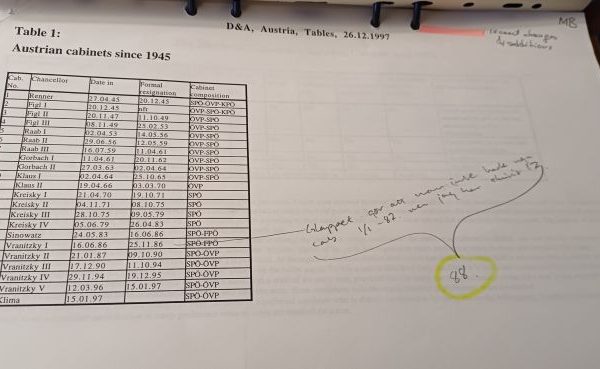
The REPDEM builds on various data collection efforts since 1997, and has resulted in several volumes that discuss, summarise and contextualise the data. Our data archive traces its origins to the literature inspired by William H. Riker’s (1962), The theory of political coalitions, and the empirical applications that has followed in this tradition. The comparative data collection began with an effort by Wolfgang C. Muller and Kaare Strom (1997) to organize a volume on West European patterns of coalition government. This volume in German was also one of the very first that took a dynamic approach to coalition governments in the sense that it investigated several phases in the “life cycle” of cabinets and coalitions: formation bargaining, formation duration, ministerial portfolio distribution, the period in power (governance), as well as cabinet duration and termination. An updated version of this book was later (2000) published by Oxford University Press. This was followed by a volume by Strøm, Müller, & Bergman (2003), which focused on the institutional design of West European parliamentary democracies from a delegation and accountability perspective. From this effort we have a continued to measure and to include the different institutional designs that have an impact on party politics and coalition politics in the countries that we include in our data archive.
Later we extended the data collection to include also Central Eastern Europe (2019), we updated the data on Western Europe by a volume edited by Bergman, Bäck, & Hellström (2021) and in so doing we further highlighted the governance phase which has been the most under-researched of the different phases in the coalition lifecycle. Our latest comparative data collection was summarized in Bergman, Ilonszki, & Hellström (2024) and further included data that makes possible comparisons within and between the regions of Western and Central Eastern Europe. Currently we are working on the first major data collection of government coalitions and coalition governance in parliamentary democracies outside of Europe.
From 2015, we have been working on building REPDEM into a collaborative national infrastructure. In 2020 this resulted in DEMSCORE, a national data infrastructure for contextual data.
Selected Edited Volumes over the Years
Bergman, Torbjörn, Gabriella Ilonszki, and Johan Hellström, eds. (2024) Coalition Politics in Central Eastern Europe: Governing in Times of Crisis. London: Taylor & Francis.
Bergman, Torbjörn, Hanna Bäck, and Johan Hellström, eds. (2021) Coalition Governance in Western Europe. Oxford: Oxford University Press.
Bergman, Torbjörn, Gabriella Ilonszki, and Wolfgang C. Müller, eds. (2019) Coalition Governance in Central Eastern Europe. Oxford: Oxford University Press.
Strøm, Kaare, Müller, Wolfgang C. and Bergman, Torbjörn eds. (2008) Cabinets and Coalition Bargaining: The Democratic Life Cycle in Western Europe. Oxford: Oxford University Press. (Paperback 2010).
Strøm, Kaare, Müller, Wolfgang C. and Bergman, Torbjörn eds. (2003) Delegation and Accountability in Parliamentary Democracies. Oxford: Oxford University Press. (Paperback 2006).
Müller, Wolfgang C. and Kaare Strøm, eds. (2000) Coalition Governments in Western Europe. Oxford: Oxford University Press.
Müller, Wolfgang C. and Kaare Strøm, eds, (1997) Koalitionsregierungen in Westeuropa: Bildung, Arbeits weise und Beendigung. Vienna: Signum.
