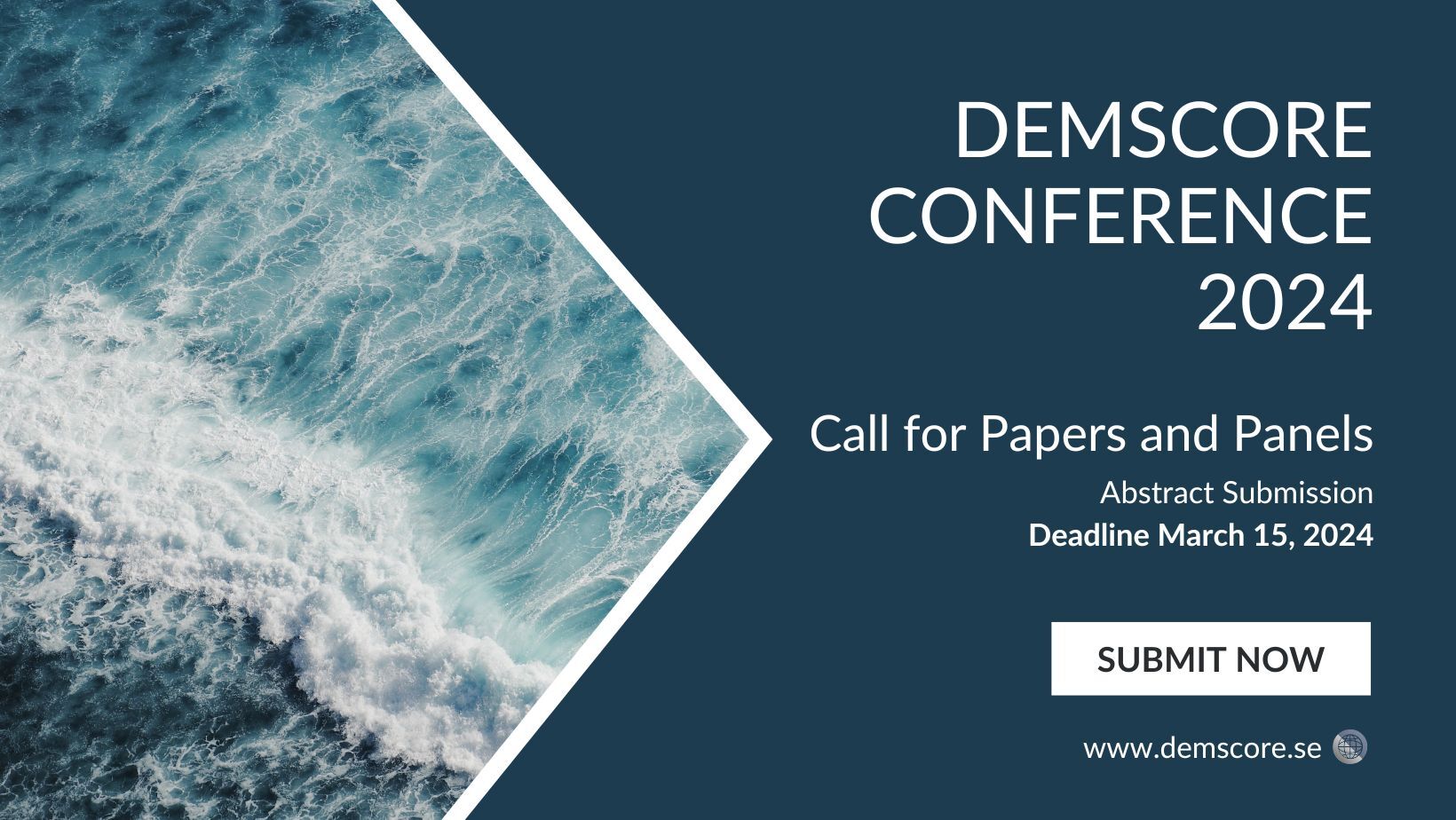
Submit your Paper Abstract or Panel/Workshop Proposal by March 15. For more information, please visit: https://bit.ly/3RXjq8V
Read More
DEMSCORE Conference 2024
- 2024-02-15
- Comments off
Submit your Paper Abstract or Panel/Workshop Proposal by March 15. For more information, please visit: https://bit.ly/3RXjq8V
Read More
We are happy to announce a major data release that provides detailed information on important aspects of government formation, coalition governance, and government termination in 28 European countries until 2022.
The dataset combines and expands data that was collected for Coalition Politics in Central Eastern Europe (2024), Coalition Governance in Western Europe (2021), and Coalition Governance in Central Eastern Europe (2019).
Read More
This book provides an updated analysis of coalition governance in Central and Eastern European democracies, examining the impact of economic and social challenges, such as the end of the economic crisis and the Coronavirus pandemic. It features contributions from experts in party politics and coalition studies from countries including Bulgaria, Czechia, Estonia, Hungary, Latvia, Lithuania, Poland, Romania, Slovakia, and Slovenia, offering insights into party system development and coalition dynamics from the 1990s to 2021. Ideal for scholars and students of coalition politics, democracy, governance, political parties, and European politics.
Read More
We are happy to announce the data release Party Government in Europe Database (PAGED) – Basic dataset.
This comparative dataset builds on previous data collection projects on REPDEM and provide an in-house update of much of the data to mid-2023.
Read More
In a new special issue on “Coalition Dynamics: Advances in the Study of the Coalition Life Cycle” several of the contributions use the REPDEM data to investigating various aspects of coalition politics.. Guest Editors are Hanna Bäck, Johan Hellström and Wolfgang C. Müller.
Read More
The Historical Cabinets (H-CAB) dataset is a historical extension of (some of) the data on governments available at REPDEM and covers cabinets formed between 1919 and 1945 in 12 European countries (Austria, Belgium, Denmark, Finland, France, Germany, Iceland, Ireland, Netherland, Norway, Sweden, United Kingdom).
The H-CAB dataset provides data on dates of cabinet formation and dissolution, along with data on the cabinet party composition, allowing for analysis of cabinet formation and duration during the interwar period.
Read More
Party Government in Europe Database (PAGED) is a research infrastructure project that aims to build a state-of-the-art database for comparative coalition research on political institutions, political parties, parliaments and governments.
This infrastructure project builds on the previous international and comparative projects on European parliamentary democracy that are available here on REPDEM – The Representative Democracy Data Archive and concern key issues of today s representative democracy namely delegation, accountability, government formation, governance and government dissolution.
Read More
We are happy to announce the second data release for the project Party Government in Europe Database (PAGED). This comparative dataset combines the datasets that was collected for Coalition Governance in Central Eastern Europe (2020), edited by Torbjörn Bergman, Gabriella Ilonszki, and Wolfgang C. Müller, and Coalition Governance in Western Europe (2021), edited by Torbjörn Bergman, Hanna Bäck, and Johan Hellström.
Read More
We are happy to announce the first data release for the project Party Government in Europe Database (PAGED). The first data release covers 16 West European countries and Croatia for the period 1945–2019.
The data were collected for the volume Coalition Governance in Western Europe.
Read More
“This book covering the full life-cycle of coalitions from the formation of party alliances before elections to coalition formation after elections (or in the sitting parliament), portfolio distribution among the coalition parties, governing and policy-making when parties work together in office, and the stages that eventually lead to government termination.“
Read More